
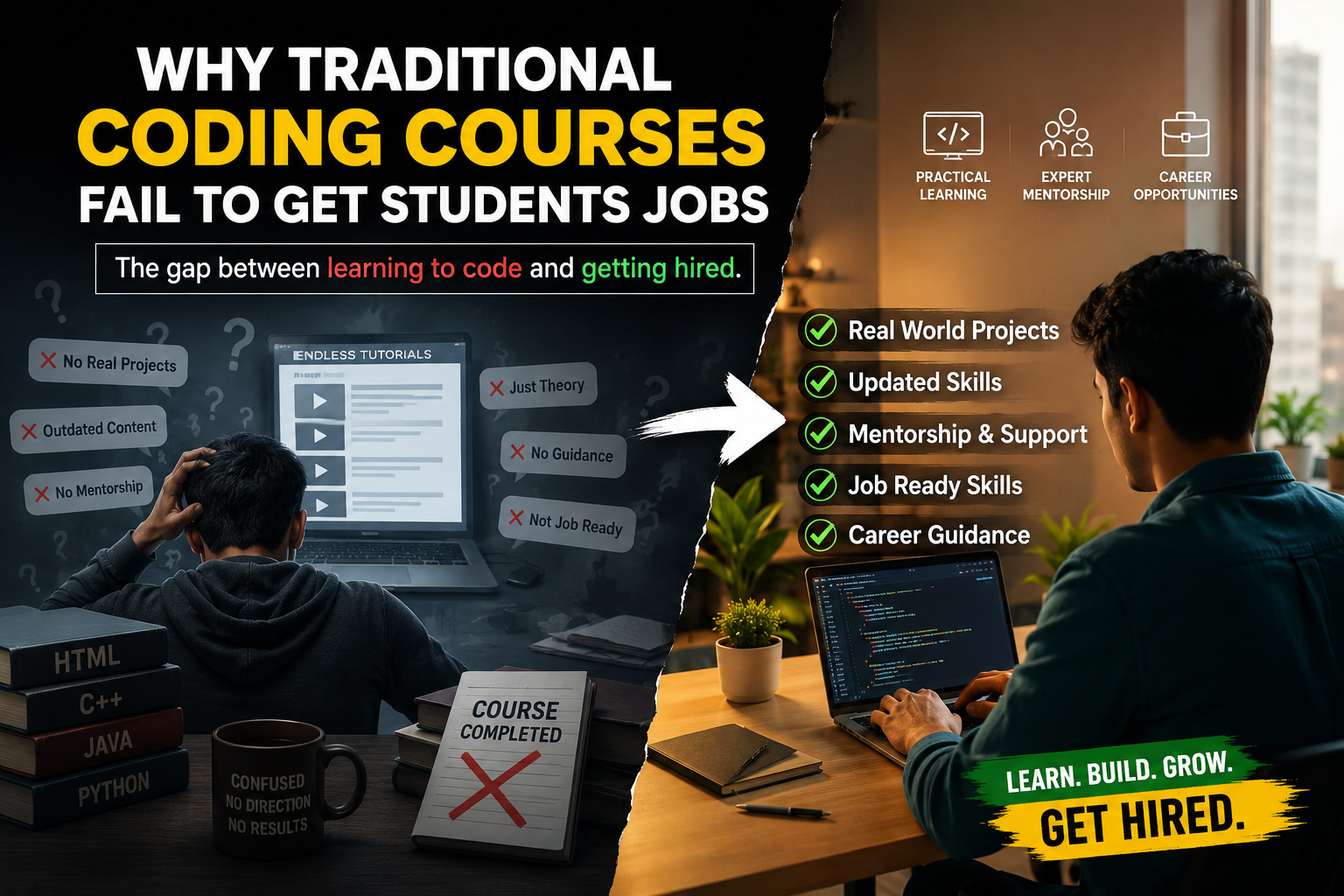
Why Traditional Coding Courses Fail to Get Students Jobs
Every year, thousands of students enroll in coding courses with dreams of becoming software engineers, data analysts, backend developers, or tech professionals.
They complete tutorials.
They earn certificates.
They spend months — sometimes years — learning.
Yet many of them still struggle to get internships, freelance projects, or full-time jobs.
Why?
The problem is not a lack of intelligence.
The problem is not a lack of effort.
The real problem is how coding is being taught.
Most Courses Teach Syntax, Not Problem Solving
Traditional coding courses often focus heavily on syntax.
Students learn:
- loops
- functions
- variables
- frameworks
- definitions
But when they are asked to build something independently, many feel completely lost.
Why?
Because real-world software engineering is not about memorizing syntax.
It is about:
- solving problems
- debugging issues
- designing systems
- thinking logically
- adapting to new technologies
Companies do not hire people just because they know the definition of an API or a framework.
They hire people who can use technology to solve real problems.
Tutorial Hell Is Real
Many students spend months watching endless tutorials without actually building anything on their own.
At first, tutorials feel productive.
But eventually, students become dependent on step-by-step guidance.
The moment the tutorial ends, confusion begins.
This is commonly called “Tutorial Hell.”
And it is one of the biggest reasons students fail to become job-ready.
Watching someone else code is not the same as building projects independently.
Real learning begins when you start struggling, experimenting, failing, debugging, and solving problems yourself.
Most Student Portfolios Look Identical
Another major issue is the lack of originality.
Thousands of students build the exact same projects:
- weather apps
- basic to-do lists
- calculator apps
- copied portfolio websites
Recruiters see these projects every single day.
Certificates and copied projects no longer stand out.
What companies really want to see is:
- practical thinking
- real-world problem solving
- creativity
- clean architecture
- understanding of tools and workflows
A strong portfolio is not about quantity.
It is about showing that you can build something meaningful and understand how modern development actually works.
Technology Changes Faster Than Traditional Courses
The tech industry evolves extremely fast.
AI-assisted development, cloud computing, automation, backend scalability, prompt engineering, and modern data systems are changing how software is built.
But many traditional courses still teach outdated approaches.
Some institutes continue teaching technologies and workflows that are no longer aligned with industry expectations.
As a result, students complete courses but remain disconnected from what companies actually need.
Learning technology without understanding industry direction is like preparing for yesterday’s jobs instead of tomorrow’s opportunities.
Job Readiness Requires More Than Coding
Many coding programs ignore the practical skills that companies expect from developers.
Technical knowledge alone is not enough.
Students also need:
- Git and GitHub knowledge
- debugging skills
- project structuring
- deployment understanding
- teamwork experience
- communication skills
- resume building
- interview preparation
- API integration knowledge
- problem-solving mindset
The gap between “learning coding” and “becoming employable” is much bigger than most students realize.
Learning Without Mentorship Often Fails
The internet has unlimited free resources.
But information alone does not create careers.
Students often feel overwhelmed:
- What should I learn first?
- Which technologies matter most?
- Am I learning correctly?
- Am I industry-ready?
Without proper mentorship and structured guidance, many lose consistency and direction.
Watching videos is easy.
Becoming industry-ready requires:
- feedback
- practical implementation
- accountability
- guidance from experienced professionals
That is where mentorship becomes powerful.
The Industry Rewards Skills — Not Certificates
A certificate may help your resume look better.
But certificates alone do not get jobs.
The tech industry rewards people who can:
- build
- solve
- adapt
- learn continuously
- think like engineers
That is the difference between simply completing a course and becoming truly job-ready.
Why We Believe Learning Needs to Change
At Codixian, we believe coding education should focus on real-world skills, practical implementation, and future-ready learning.
Technology is evolving rapidly.
Students need more than outdated tutorials and theoretical lessons.
They need:
- industry-focused learning
- real projects
- mentorship
- modern tools
- practical workflows
- future-oriented skills
Because the goal is not just to learn coding.
The goal is to build a career.
Final Thoughts
Learning to code is only the beginning.
The real challenge is learning how to think, solve problems, and adapt in a fast-changing industry.
Traditional coding education often fails because it focuses too much on completing lessons and too little on building real capability.
The future belongs to learners who can combine technical skills, practical experience, and continuous growth.
In the end, companies do not hire people who simply completed courses.
They hire people who can create value.
Need Guidance?
If you feel confused about where to start, what skills to learn, or how to become industry-ready, you are not alone.
At Codixian, we help students learn practical, future-focused skills with proper mentorship and real-world guidance.
Whether you want to become a:
- Data Analyst
- Data Engineer
- Backend Developer
- Software Engineer
- AI/Prompt Engineer
we are here to help you build the right path.